EXCELLENT Based on 155 reviews
 Posted on Tripadvisor
 Kornel P23 August 2026Superb experience in the land of the thunder dragon Absolutely amazing experience, our guide was extremely knowledgeable and had a superb ability to talk about all that he knew. We learned a lot about Bhutan and truly enjoyed every part of our 4 day stay it was quite extensive. Highly recommend to anybody looking to visit and understand Bhutan.Posted on Tripadvisor
 Kierthini N22 August 2026An Authentic, Meaningful Bhutan Experience Thank you, Omsha Travel, for making this journey so much more than just an itinerary. I’m was a solo female traveler from Malaysia and I stayed in Bhutan for 8 days. I had done my own research and revised the itinerary based on the places and experiences I wanted to cover. Mr. Nawang took that and made it happen while also adding in experiences I could have easily missed. That was the best part. He understood what I wanted from this trip and helped me experience and explore Bhutan more wholesomely, with so much thought and hospitality along the way. And then came Mr. Lhazin, quite possibly the best guide I could have asked for. This trip truly became a spiritual journey for me. We spoke about so many things; religion, beliefs, life and perspectives and it was refreshing to exchange opinions and have meaningful conversations. His knowledge of nature was mind blowing, and I genuinely learnt so much from him. Then there was Mr. Tashi, who drove me through all the “scenic” roads I kept requesting because I wanted to experience Bhutan in its rawest form. And he made it happen, while constantly making sure I was safe. These two made sure I ticked off my bucket list while keeping me safe, exactly what my family is always worried about. So, fam, that part was well taken care of! I came to Bhutan looking for an experience, but I’m leaving with stories, perspectives, knowledge and two people I’ll genuinely remember. Thank you, Omsha Travel, Mr. Nawang, Mr. Lhazin and Mr. Tashi, for making my journey through Bhutan so wholesome.Posted on Tripadvisor
 Rivet L22 August 2026A trip of a lifetime with the perfect team I had an amazing time with OMSHA Travel in Bhutan. Since the first email exchange I have felt very well taken care of, they were incredibly responsive and willing to accommodate each and every of my adjustment requests and travel plan changes. After arriving in Bhutan my lovely guide Sonam picked me up from the airport together with the driver Nawang. Sonam is very kind and knowledgeable, I had so many questions about the culture, every day life, food, Buddhism, and she always had an answer to satisfy my curiosity. As it was a private tour, they gave me the flexibility to adjust our route as we were going too! Nawang is a great driver and such a sweet person! The car was very comfortable and all the accommodation chosen for me beautiful and picturesque. People surrounding me were all so very nice, it really felt like making good friends while exploring this beautiful country. I'm definitely coming back some time in the future and I'm definitely recommending OMSHA to all my friends! Thank you Sonam and Nawang!Posted on Tripadvisor
 Tomasz P16 August 2026Mindful experience and more Great experience and exploring of Bhutan with lovely people. We had a tailor made offer for our near 4 day stay. Appreciate the flexibility and helpfulness in organization of our trip and the full package. Friendly and knowledgeable guide helped us to understand the country, culture and people. We enjoyed every moment of this fascinating trip.Posted on Tripadvisor
 Jorg H12 July 2026perfect days in Bhutan We were so lucky to have Sonam as our guide for our 8 day tour of Bhutan. Everything along the way was perfect and we had no difficulties at all. Sonam was friendly, funny and entertaining, but what really blew us away was her knowledge of the history of Bhutan and Buddhism and her ability to tell the stories and legends of the various characters in Buddhism that we encountered. He knowledge really helped to enhance our enjoyment of Bhutan as well as our other travels into Tibet and China. I also want to mention our driver Nawang. He was a very calm and careful driver and we appreciated his driving over some challenging roads. We never felt scared or nervous and he never lost his cool, or became frustrated with other drivers. Overall, our guide and driver team made our trip to Bhutan easy, educational, fun, interesting, safe and fantastic!! The tour itself was well thought out, customized according to our interests, competitively priced and communication with Ngawang (not sure about spelling) the owner was very timely and clear.Posted on Tripadvisor
 Rita D3 July 2026Excellent Price to Value Tour Fabulous Tour! We appreciated that OMSHA was responsive from inquiry to final booking. Price to value was excellent. We liked the selected itinerary and appreciated that we could make changes as needed. Our guides Sonam and Tashi were knowledgeable and professional and we had great conversations. It felt more like traveling with friends than with a tour. I would highly recommend OMSHA. You won't be disappointed!Posted on Tripadvisor
 Michael S16 June 2026Hassle free and flexible Communication was quick and clear from the start. Personable. Individualized itineraries but hassle free. Flexible. Tour guide was great at adjusting plans to better fit my style as the trip progressed. Undoubtedly the way to go. No regrets!Posted on Tripadvisor
 rayaro15 June 2026Marvelous Bhutan We had a group of friends and family on 7 days tour of Western Bhutan. Level of service provided by OMSHA travel was unmatched in many areas. From the pick up at the airport, Sonam and Ganesh kept our exploration of Bhutan flawless. Our requests to visit specific areas and activities were accommodated. We spent a night in a homestay in Gasa, visited hot springs, had a lovely riverside birthday picnic and attended Folklore Show that was a highlight of our trip. Nawang handled all communications and financial details thoroughly and transparently.Posted on Tripadvisor
 Wander340623001438 June 2026Amazing Bhutan We traveled to Bhutan in June 2026, and Omsha Travels made our holiday a truly wonderful experience. From the very beginning, the booking process was seamless and professional. The entire trip was planned to perfection, allowing us to relax and fully enjoy the beauty, culture, and unique environment of Bhutan. A special thanks to the owner for the warm hospitality and excellent arrangements. We are also grateful to our tour guide, Lhazin Dorji, whose knowledge and enthusiasm helped us gain a deeper understanding of Bhutan’s rich culture and way of life. He was really accommodating and helped fulfill our every wish. Our driver was equally wonderful, ensuring a safe, comfortable, and enjoyable journey. This holiday gave us unforgettable memories and a genuine glimpse into the amazing lifestyle and traditions of Bhutan. We are very happy clients and would highly recommend Omsha Travels to anyone planning a visit. We look forward to returning again in the future!Posted on Tripadvisor
 Anya B7 June 2026Unforgettable trip to Bhutan! A wonderful experience from start to finish! One of the most memorable trips we have taken. Sonam was knowledgeable, attentive & passionate about sharing Bhutan. We appreciated the warmth and kindness shown throughout the journey. We leave Bhutan with wonderful memories and a much greater appreciation for this remarkable country.
Bhutan Tour Packages:
Adventure
Festivals
Travel Tips:
Blog Posts:
- Inside Amankora Bhutan: A Private Journey Through the Himalayas
- Planning to Visit Bhutan for Festivals in 2027? Best Festivals, Dates & Planning Guide
- Bhutan Travel Guide 2027: Everything You Need to Know Before You Go
- Visit Druk Wangyel Festival in December: A Guide to Dochula Pass
- Nabji Lhakhang Drup 2026: An Offbeat Bhutan Festival in December
Contact us:
Ask anyone who has priced out a trip to Bhutan and you’ll hear the same complaint: the flights cost more than the rest of the holiday combined. It’s not an exaggeration. A short hop from Bangkok, Delhi, or Kathmandu to Paro can run into the hundreds of dollars each way — sometimes rivaling long-haul intercontinental fares. And Bhutanese travellers feel it too, which is why a growing number of people, both tourists and locals, are choosing to skip the flight altogether.
So Why Are Bhutanese Airfares So High in the First Place?
A few structural factors combine to keep prices elevated, and none of them are going away quickly.
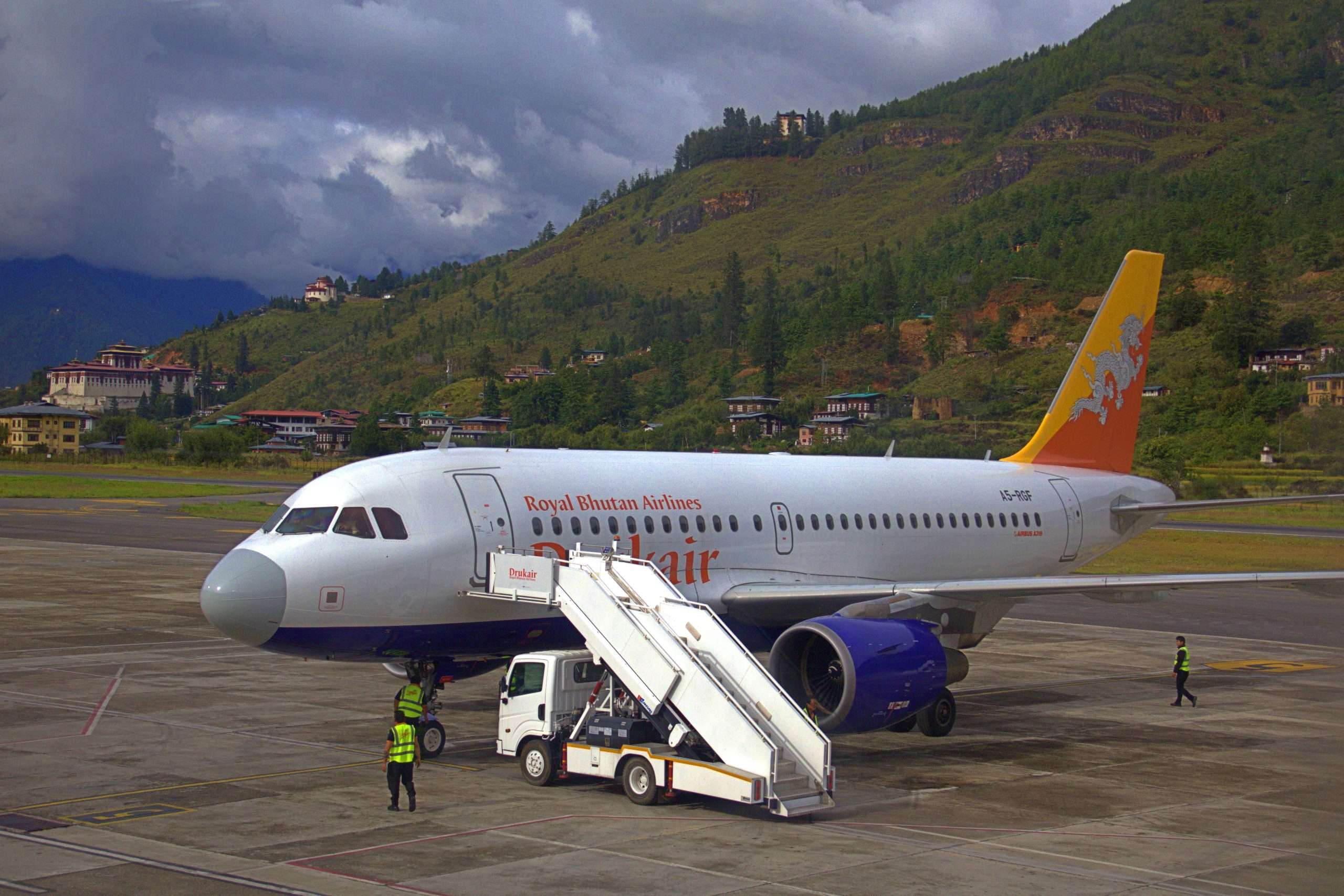
1. It’s a two-airline market, and that’s essentially it. Only two carriers fly into Paro: Drukair (the national flag carrier) and Bhutan Airlines (operated by Tashi Air). Between them they run a combined fleet of only around eight narrow-body A319/A320 aircraft, covering a handful of gateway cities — mainly Delhi, Bangkok, Singapore, and Kathmandu. With no low-cost competitor allowed to undercut them, there’s little competitive pressure pushing fares down.
2. Fares are fixed by regulation, not by demand. Unlike most airlines, Drukair and Bhutan Airlines operate under government-regulated fare bands set by distance and cabin class. That means there’s no dynamic pricing, no early-bird discount, and no last-minute sale — a ticket booked six months out costs the same as one bought two weeks before departure. Waiting for a fare to drop simply doesn’t work in Bhutan’s market the way it does elsewhere; the only thing that changes as the date approaches is seat availability, not price.
3. Paro Airport itself is a hard place to fly into. Paro is one of the most technically demanding commercial airports in the world, tucked into a narrow Himalayan valley and certified for only a small number of specially trained pilots. It operates under Visual Flight Rules, meaning aircraft can only land and take off in daylight with clear visibility — there are no night flights, and the entire day’s schedule is compressed into a narrow morning-to-afternoon window. That operational complexity limits how many flights can realistically be scheduled and adds to per-flight costs.
4. Limited capacity meets high-demand festival seasons. During peak periods — especially the Paro and Thimphu Tshechu festivals — flights on the main routes can reach seat-load factors above 95 percent months in advance. With a small combined fleet and no ability to simply add more aircraft on short notice, high demand doesn’t translate into more seats; it just means the same limited seats sell out faster, at the same fixed high price.
5. Even the “cheaper” airline isn’t cheap. Bhutan Airlines is generally the more affordable of the two when both serve the same route, but the difference is marginal in the context of overall trip cost. Route-dependent fares can still run well over $500–$1,000 round-trip depending on the gateway city and season, and popular routes like Bangkok–Paro tend to sit at the higher end.
Will Airfares Come Down Anytime Soon?
Not obviously, and not soon. The constraints are structural — a two-airline duopoly, a small shared fleet, a technically restrictive airport, and a regulated fare system — rather than the kind of temporary spike that resolves itself with a new competitor entering the market. Unless Bhutan’s civil aviation authorities revisit the fare-setting framework, expand capacity, or open the market to additional carriers, the underlying economics that make flying into Paro expensive aren’t likely to shift much in the near term.
For now, the practical reality for many travellers — and increasingly for Bhutanese citizens themselves — is that the “scenic flight into the Himalayan kingdom” many imagine is being replaced by a much less romantic road trip through Bagdogra and Phuentsholing.