Bhutan Tour Packages:
Adventure
Festivals
Travel Tips:
Blog Posts:
- Traveling from Israel to Bhutan in 2027: Flights, Visa & Travel Guide
- When Is the Best Time to Visit Bhutan in 2027?
- Bhutan SDF 2027: Sustainable Development Fee Explained
- How to Get to Bhutan in 2027: Best Flight Routes via Kathmandu, Delhi, Bangkok & More
- Inside Amankora Bhutan: A Private Journey Through the Himalayas
Contact us:
You’ve heard it a hundred times: ‘Don’t go to Bhutan in monsoon.’ But here’s the thing — the people saying that have never watched mist pour through a mountain valley at dawn, never stood at Punakha Dzong as the Mo Chhu runs wild and jade-green, never tasted a bowl of ema datshi while rain drums on a farmhouse roof. They’ve missed something.
The monsoon season in Bhutan — roughly June through mid-September — gets a bad reputation. Guidebooks warn you off it. Travel agents nudge you toward October. And yes, it rains. Sometimes a lot. But Bhutan in the monsoon is a different country from Bhutan in the dry months, and for certain travelers, it’s actually the better one.
This is the guide that cuts through the clichés. Here’s what nobody tells you about visiting Bhutan when the rains come.
First, let’s be honest about the rain
Monsoon in Bhutan is not like the monsoon in Bangkok or Bali. The rains here are mostly afternoon and evening affairs — mornings are frequently clear, sometimes brilliantly so, with the washed Himalayan air revealing snow peaks you’d never see through the October haze. The western valleys of Paro, Thimphu, and Punakha receive less rainfall than the south and east, making them reliably navigable throughout the season.
What you’ll actually encounter: overcast skies by midday, a downpour for a few hours, then cool, clean evenings. The roads in western Bhutan are mostly paved and well-maintained. Landslides are a genuine risk on remote mountain roads in the east — but if your itinerary stays west of Trongsa, you’ll rarely be stopped.
Here’s the honest breakdown:
Region | Monsoon Reality |
Paro & Western Bhutan | Moderate rain, mornings mostly clear, roads reliable |
Thimphu Valley | Afternoon showers, culturally rich, fully accessible |
Punakha | Lush and dramatic — the most beautiful in monsoon |
Bumthang (Central) | Wetter, cooler, but roads generally open |
Eastern Bhutan | Heaviest rain, road closures possible — plan carefully |
The monsoon myth: why travelers avoid it (and why that’s your advantage)
The ‘don’t visit in monsoon’ advice was sensible advice in the 1990s, when most roads were unpaved and the country had a handful of guesthouses. Today, Bhutan has paved highways across the west, world-class lodges, and a domestic flight network that bypasses road conditions entirely.
The result of this outdated advice? Monsoon Bhutan is blissfully uncrowded. The Tiger’s Nest trail has breathing room. Punakha Dzong — mobbed in October — becomes a place where you can sit quietly in a courtyard and hear monks chanting. Guesthouses that are impossible to book in October have rooms available. Guides who spend autumn shepherding tour groups give you their full attention.
This is one of the world’s great undiscovered travel windows — for now.
What monsoon Bhutan actually looks like
There’s a reason landscape photographers come in June and July. The monsoon transforms Bhutan into something otherworldly.
The green
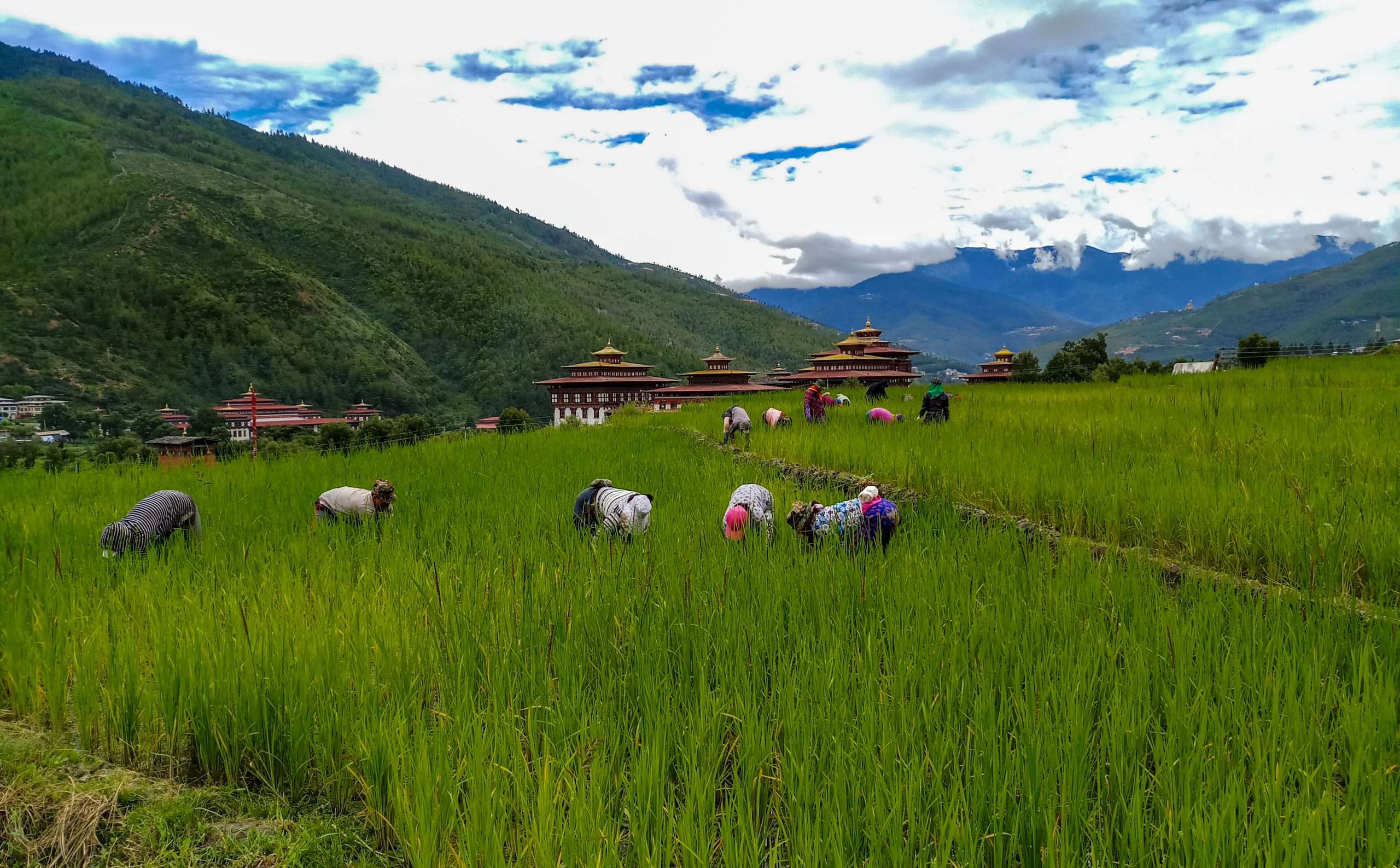
Bhutan’s forests — which cover 71% of the country — go from dusty spring green to an almost unreal emerald. Rice terraces in Punakha Valley turn vivid and geometric. The valleys between Paro and Thimphu, usually a mix of brown and green, become wall-to-wall lush. Wildflowers appear on high passes. Every stream runs clear and fast.
The mist
The photographs that stop people in their tracks — monastery floating above a sea of cloud, dzong walls rising out of morning fog — are monsoon photographs. The dramatic light and low cloud create conditions that photographers spend years trying to replicate artificially. In monsoon Bhutan, you get it for free every morning.
The iconic shot of Tiger’s Nest monastery half-wrapped in mist? That’s a monsoon shot. October gives you blue skies. Monsoon gives you atmosphere.
What actually works in monsoon (the real list)
Cultural experiences — all of them
Monastery visits, dzong tours, archery demonstrations, traditional craft workshops, farm stays — none of this is affected by rain. In fact, monasteries feel more alive and meditative in grey weather. Several monasteries and temples that are closed or reduced hours in peak season are fully operational in the quieter months.
Attractions Without Crowds
Imagine hiking to Tiger’s Nest Monastery and hearing only the sounds of prayer flags fluttering in the wind.
During peak seasons, popular sites can become busy. In summer, however, many of Bhutan’s most famous attractions feel remarkably peaceful.
You may find yourself sharing a monastery courtyard with only a handful of visitors—or none at all.
The experience becomes slower, quieter, and more personal.
Easier Flight Availability
Flights to Bhutan can be difficult to secure during busy travel periods.
During July and August:
- Flights are less crowded.
- Last-minute bookings are easier.
- Preferred travel dates are often available.
- Window seats are easier to obtain.
The famous approach into Paro Valley remains one of the world’s most spectacular flights regardless of the season.
Punakha Valley — at its absolute peak
If you visit Bhutan in one monsoon month, make it June or early July, and spend at least two nights in Punakha. The valley is at its most extraordinary: the Mo Chhu and Pho Chhu rivers swell to full, deep jade; the rice terraces are newly planted and impossibly green; Punakha Dzong — built at the confluence of two rivers — seems to float. The suspension bridge, the Chimi Lhakhang fertility temple, the walk to Khamsum Yulley Namgyal Chorten through rice fields: all magnificent.
Wellness and slow travel
Monsoon Bhutan rewards the unhurried traveler. Hot-stone baths (dotsho) are especially restorative on cool, rainy evenings. Forest therapy walks — Bhutan has some of the world’s most pristine old-growth forest — take on an entirely different quality in the green season. Spa treatments at the country’s lodge properties are easier to book and often priced more generously.
Day hikes — with caveats
Lower-altitude hikes remain excellent throughout monsoon. The Paro valley walks, the hike around Thimphu’s Tango Monastery, the Cheli La Pass in early morning — all fine. The main path to Tiger’s Nest is walked year-round by locals and visitors alike; just start early before afternoon cloud and bring light rain gear. What doesn’t work: multi-day high-altitude treks in exposed terrain, which become genuinely dangerous when wet.
What to skip (honestly)
|
Summer Festivals Most Tourists Miss
Many travelers associate Bhutanese festivals with autumn, but summer hosts some of the country’s most authentic cultural celebrations.
The Nimalung Tshechu Festival
Held at Nimalung Monastery in Bumthang Valley, usually in July, this is one of Bhutan’s most intimate and authentic festivals — and most international visitors have never heard of it. Masked Cham dances, local families in traditional dress, monks in elaborate ceremonial robes, and you might be one of only a handful of foreign visitors present. It’s the kind of festival experience that Paro Tshechu was before it became famous.
Matsutake Mushroom Festival
Held in the beautiful Ura Valley of Bumthang, the Matsutake Mushroom Festival celebrates one of Bhutan’s most prized natural delicacies.
Visitors can:
- Join local mushroom foraging trips
- Learn traditional harvesting methods
- Taste unique mushroom dishes
- Experience village life firsthand
It offers a fascinating glimpse into rural Bhutanese culture that few international travelers experience.
Kurjey Tshechu
Held at one of Bhutan’s most sacred sites in Bumthang, Kurjey Tshechu provides an intimate opportunity to witness living Buddhist traditions in a setting largely shared with local devotees.
Luxury for Less: Bhutan’s Best-Kept Secret
Bhutan is known as an exclusive destination, but summer offers one of the best opportunities to enjoy luxury travel at exceptional value.
Better Hotel Rates
With fewer visitors during monsoon season, many premium hotels offer attractive promotions.
Luxury resorts that are often fully booked during spring and autumn may provide:
- Seasonal discounts
- Complimentary upgrades
- Extra nights included in packages
- Special wellness and spa offers
This means travelers can enjoy world-class Bhutanese hospitality for significantly less than during peak season.
The Practical Truths About Summer Travel
Every season has advantages and disadvantages, and Bhutan’s monsoon season is no exception.
You May Not See Himalayan Peaks
If your primary goal is photographing snow-covered Himalayan summits such as Jomolhari, winter offers better visibility.
Summer clouds often conceal the highest mountains.
However, many travelers find that the dramatic mist and atmospheric landscapes more than compensate for the lack of distant peak views.
Leeches Exist
Leeches appear on damp forest trails during the rainy season.
The good news?
They are mostly found in forested areas rather than towns or major sightseeing locations.
Experienced local guides know exactly how to avoid and remove them, and simple remedies such as salt or tobacco are highly effective.
For most visitors, they become little more than a funny travel story.
Occasional Road Delays
Heavy rain can occasionally trigger minor landslides or temporary road closures.
Fortunately, Bhutan’s road maintenance teams respond quickly, and most disruptions are cleared within a short period.
The trade-off is significant: while others travel during crowded months, you’ll often enjoy Bhutan’s most famous attractions almost entirely to yourself.
Flights and logistics
Paro Airport sometimes experiences delays in heavy rain or low cloud — build in buffer days at the end of your trip rather than booking a tight connection home. Druk Air and Bhutan Airlines both fly to Paro; from Singapore, Bangkok is the most common connecting hub, with Kolkata and Delhi also options. From Australia, fly Singapore-Kolkata-Paro or Singapore-Bangkok-Paro. From the US and Europe, the most reliable routing is your home city to Delhi or Kolkata, then onward to Paro.
What to pack
Monsoon packing essentials
|
The Best Way to Experience Bhutan in Summer
Monsoon season rewards travelers who slow down.
Instead of rushing between landmarks, spend time:
- Walking through rice fields in Punakha
- Enjoying tea while clouds drift across Paro Valley
- Visiting village temples without crowds
- Speaking with monks and local families
- Exploring forest trails rich with summer life
This is Bhutan at its most intimate and authentic.
Who Should Visit Bhutan During Monsoon Season?
Summer is perfect for travelers who:
- Prefer fewer tourists and quieter attractions
- Love photography and atmospheric landscapes
- Enjoy lush green scenery
- Appreciate cultural immersion
- Seek better value from luxury hotels
- Like spontaneous and flexible travel
If your dream is crystal-clear Himalayan panoramas every day, winter may be a better choice.
But if you’re looking for a more personal, immersive, and unexpectedly beautiful experience, Bhutan’s Emerald Season might become your favorite time to visit.
Final Thoughts
The biggest misconception about Bhutan’s monsoon season is that it should be avoided.
In reality, July and August reveal a side of the kingdom that many travelers never see: vibrant green valleys, mystical cloud-covered monasteries, authentic local festivals, warm summer weather, and an atmosphere of peace that becomes increasingly rare in today’s world.
While others wait for the traditional travel seasons, those who visit during the monsoon often discover Bhutan at its most enchanting.
Sometimes the best time to visit a destination is precisely when everyone else stays away.
Planning a monsoon Bhutan trip? Browse our curated June–September Bhutan itineraries, built specifically for the green season — with lodge picks, festival dates, and guides who know this country in the rain. |